

New AI and Blockchain Framework Breaks the Battery Sustainability Trilemma
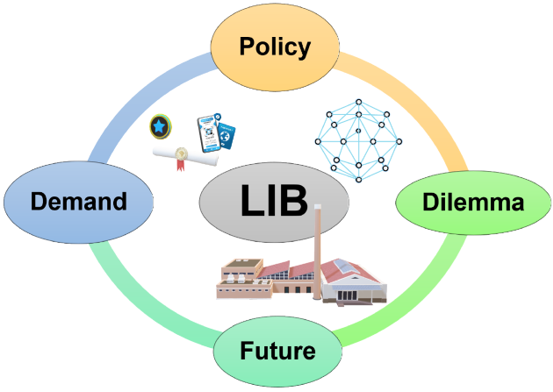
From demand to solutions: Mapping the LIB sustainability trilemma.
FAYETTEVILLE, GA, UNITED STATES, July 7, 2026 /EINPresswire.com/ -- The global push for electric vehicles and energy storage has created a fundamental tension: lithium-ion batteries (LIBs) are essential for decarbonization, yet their production depends on finite metals whose supply chains are geopolitically concentrated and environmentally costly. A new perspective argues that the industry faces a “sustainability trilemma”—the conflicting demands of rapid decarbonization, resource security, and economic viability. The authors propose an integrated framework that combines smart regulations, AI-enhanced modular recycling systems, and blockchain-tracked material certificates to break this deadlock and decouple battery growth from virgin resource dependence.
Global LIB shipments surged from 58.1 gigawatt-hours (GWh) in 2017 to 1,545.1 GWh in 2024—a 2,559% increase. Lithium consumption for batteries now exceeds 87% of global output, while 69% of cobalt originates from the Democratic Republic of the Congo and 80% of lithium production is concentrated in Australia and Chile. Meanwhile, recycling efforts lag: even under optimistic projections, secondary lithium supplies will satisfy less than 12% of demand by 2040. Current approaches remain fragmented—policy targets lack enforcement, laboratory breakthroughs fail to scale, and informal recyclers undercut compliant operators by avoiding environmental controls. Given these challenges, there is an urgent need for systematic integration across policy, technology, and markets to drive in-depth research and coordinated action.
Researchers from Huaqiao University, Shanghai Jiao Tong University, and Southwest University of Science and Technology in China publish (DOI: 10.1007/s11783-026-2215-8) their perspective in ENGINEERING Environment (Volume 20, Issue 7, 2026). The study, led by Jiefeng Xiao and co-authored by Junming Hong and Zhenming Xu, identifies three interconnected systemic dilemmas that perpetuate the sustainability trilemma and proposes a coordinated circularity framework to address them.
The authors identify three barriers that collectively block progress toward sustainable LIB recycling. First, a policy-action chasm: despite China’s whitelist of 156 certified recyclers with over 2 million tons of annual capacity, significant battery volumes leak into informal channels due to weak enforcement, absent consumer incentives, and inadequate penalties. The European Union’s Battery Regulation faces similar traceability gaps. Second, a technology-market dislocation: while promising methods like direct recycling achieve over 90% lithium recovery in labs, industry remains locked into conventional hydrometallurgy—a process that handles diverse chemistries but carries higher carbon emissions and narrower profit margins. Third, a temporal disequilibrium: recovering lithium from spent batteries often costs more than mining new material, and geopolitical stockpiling—such as China’s 2023 strategic reserve of 8,700 tons of cobalt—further deprives recyclers of feedstock. Together, these dilemmas create systemic rebound effects where progress in one area undermines goals in another.
“Recycling has been treated as a compliance burden—something manufacturers do because they have to, not because it makes business sense,” the authors said. “But that framing is exactly what needs to change. What we’re proposing turns recycling into a strategic value driver: AI-driven modular systems that can adapt to different battery chemistries on the fly, blockchain-based certificates that let companies trade verified carbon reductions like commodities, and regulatory reciprocity that rewards closed-loop production across borders. If you can monetize circularity, you don’t need to rely on goodwill or mandates alone—the economics start working in sustainability’s favor.”
The framework offers concrete pathways for industry and policymakers. For recyclers, AI-enhanced physical separation and switchable metallurgical modules could reduce the cost and flexibility barriers that currently favor conventional methods. For regulators, multilateral certification reciprocity between China’s carbon trading system and the EU’s Battery Passport could create a tradable “green premium” for verified recycling. For markets, blockchain-tracked Environmental, Social, and Governance (ESG) tokens linked to material passports would embed real-time accountability into supply chains. If implemented, the approach could transform LIB recycling from a fragmented, loss-making activity into a self-reinforcing circular economy—reducing dependence on geopolitically concentrated virgin resources while keeping decarbonization on track.
References
DOI
10.1007/s11783-026-2215-8
Original Source URL
https://doi.org/10.1007/s11783-026-2215-8
Funding Information
This work was supported by the National Natural Science Foundation of China (No. 52500158), the Natural Science Foundation of Xiamen, China (No. 3502Z202372038), and the Opening Project of Key Laboratory of Solid Waste Treatment and Resource Recycle, Ministry of Education, China (No. 23kfgk04), and the Scientific Research Funds of Huaqiao University, China (No. 20221XD053).
Lucy Wang
BioDesign Research
email us here
Legal Disclaimer:
EIN Presswire provides this news content "as is" without warranty of any kind. We do not accept any responsibility or liability for the accuracy, content, images, videos, licenses, completeness, legality, or reliability of the information contained in this article. If you have any complaints or copyright issues related to this article, kindly contact the author above.
